Herstory
The vision of creating the National Commission on the Role of Filipino Women (now Philippine Commission on Women) emanated from the Philippine women’s movements or the two waves of feminism: (1) liberal feminism that emerged in the early 1900s and (2) left-of-center feminism that started in the late 1960s, comprising political formations, people’s movements, and women-only non-governmental organizations (NGOs). 1
Liberal feminism became more visible in the 1920s when it started campaigning for suffrage. It was initially spearheaded by the National Federation of Women’s Clubs, which later mobilized all major women’s groups, resulting in the 1937 plebiscite that recognized, for the first time in Asia, women’s right to vote. This first wave of feminism included welfare-oriented socio-civic women’s organizations that eventually became the Civic Assembly of Women of the Philippines (CAWP), which is now called the National Council of Women of the Philippines (NCWP).2
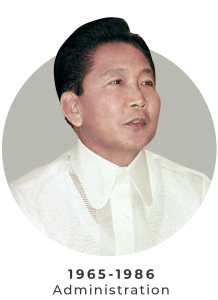
The CAWP’s intense lobbying for the creation of a national women’s machinery since the late 1960s paved the way for then President Ferdinand Edralin Marcos to pledge his support to the call, which he initially expressed in a speech3 during a regional seminar of the United Nations Commission on the Status of Women (CSW) held in Manila from December 6 to 19, 1966, almost a year after he was elected. 4
“Filipino women have always been in the mainstream of Philippine history; they have contributed their share in the most challenging task of nation building. It seems to me, then, and for many Filipinos, that the further advancement of the Filipino women will lie in their increased participation in national development. I say increased participation for, with the current status of Filipino women, they are already felt in the national scene.” – President Marcos during the UN CSW seminar on “Measures Required for the Advancement of Women with Special Reference to the Establishment of a Long-Term Programme”
During this period, Helena Z. Benitez, renowned as a four-term President of CAWP, one of the first Commissioners of the NCRFW, and a former Senator, became the first Filipino woman to head the UN CSW. She chaired the CSW from 1966 to 1970 while serving as President of the Philippine Women’s University, the first for-women university in Asia founded by Asians.
It was during her term that Benitez successfully presided over the first major policy statement adopted by the CSW, which was the Declaration on the Elimination of Discrimination Against Women (DEDAW) in 1967.5 However, while the CSW considered DEDAW an important step in securing the legal foundation for women’s equality, its impact on the ground was more limited.6
Thus, in 1974, the CSW decided, in principle, to prepare a single, comprehensive, and internationally binding instrument to eliminate discrimination against women.7 In the same year, Leticia Ramos-Shahani—recognized as the first Filipino Ambassador to a communist country, first female Diplomat in Romania, Philippines’ first woman Ambassador to Australia, a two-term Senator, the first female Senate President Pro-Tempore, and a Chairperson of the NCRFW—assumed the role of Chair of the CSW.
Since the inclusion of the World Conference on Women in the CSW agenda in 1974, Shahani led the preparations for the Philippine’s participation. She urged fellow prominent women leaders, including Helena Z. Benitez and Irene Cortes—now remembered as the first female dean of the University of the Philippines College of Law, first Vice Chairperson of the NCRFW, and an Associate Justice of the Supreme Court—to discuss the decade-long-awaited creation of a national women’s machinery.
In summary, the first wave of feminism that began in the early 1900s, the UN General Assembly call for member countries to establish a government machinery addressing women’s concerns, the designation of 1975 as “International Women’s Year”, and the second wave of feminism in the country, which was heavily influenced by the international women’s movement of the late 1960s and 1970s, collectively gave birth to the National Commission on the Role of Filipino Women.
To illustrate the position of women and the NCRFW in the history of the country, below were the series of events that transpired from the 1970s to the present:
Download the Herstory here.
1 Transforming the Mainstream Building a Gender-Responsive Bureaucracy in the Philippines 1975–1998 by Jurgette A. Honculada and Rosalinda Pineda-Ofreneo
2 Ibid.
3 National Commission on the Role of Filipino Women: Our First Year 1975. Retrieved here.
4 1966 UN Yearbook. Retrieved here.
5 Shaping the Women’s Global Agenda: Filipino Women in the United Nations Edited by Olivia H. Tripon
6 2263 (XXII). Declaration on the Elimination of Discrimination against Women. Retrieved here.
7 Short History of CEDAW Convention. Retrieved here.